
Prerequisites
AE02 competency and basic Python, NumPy, and pandas.
Turn data into reliable predictions.
Build reliable baselines, select data representations, train models, and evaluate them correctly offline. Projects may use tabular data, text classification, or simple retrieval.

AE02 competency and basic Python, NumPy, and pandas.
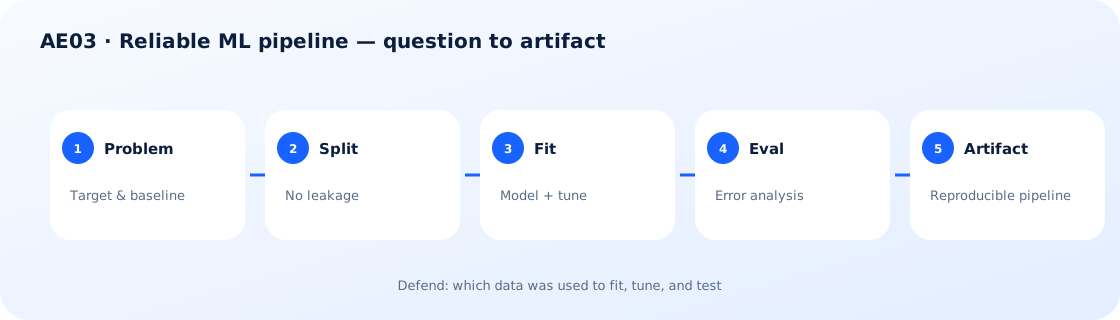
A reproducible offline pipeline, benchmark, error report, and model artifact. Learners can explain which data was used for fitting, tuning, and testing.
Software engineers moving into ML and analysts building predictive models.
Build and evaluate ML models.
| Week | First session | Second session |
|---|---|---|
| 1 | S1: Turn questions into supervised or unsupervised learning problems, then define targets and baselines | S2: Train, validation, and test sets, including time-based and group-based splits and data leakage |
| 2 | S3: Linear regression, fitting, residuals, and prediction | S4: GD, SGD, feature scaling, and regularization for regression |
| 3 | S5: Logistic regression and predictive probabilities | S6: Regression and classification metrics, thresholds, and imbalanced data |
| 4 | S7: Decision trees, splitting, impurity, and overfitting | S8: Random forests, bagging, and the bias-variance trade-off |
| 5 | S9: Gradient boosting and tabular-data baselines | S10: Cross-validation, hyperparameter search, and experiment tracking |
| 6 | S11: Feature transformation, missing data, and preprocessing pipelines | S12: PCA, dimension selection, and information-loss evaluation |
| 7 | S13: K-means and nearest neighbors | S14: TF-IDF, retrieval baselines, and search evaluation metrics |
| 8 | S15: Error analysis, calibration, and errors across data groups | S16: Defend the ML pipeline and model selection decisions |
Prepared ML environment, datasets, experiment tracking, and a list of suitable contributions.
Benchmark and first contribution package.